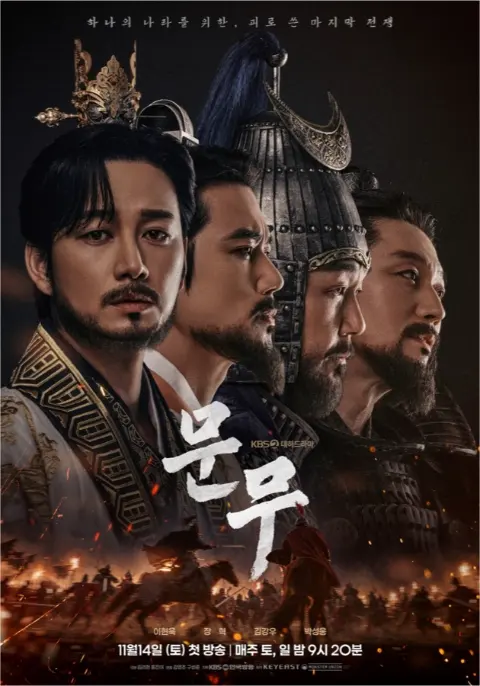
Why Kim Beopmin confronts Kim Chunchu in Munmu: drama and history
Examine Munmu episodes 1–2 through Baekryong’s death and Beopmin’s refusal to leave, compared with the 650 Tang mission and the 642 Daeya defeat.
As of November 18, 2026 / Episode 1–2 spoilers and later historical outcomes including Daeya and succession / Post-broadcast reports compared with historical records

Why does Kim Beopmin challenge Kim Chunchu?
The immediate triggers for the father–son conflict in Munmu episodes 1–2 are General Baekryong’s death and a proposed departure for Tang. Beopmin is played by Lee Hyun-wook and Chunchu by Kim Kang-woo. The son questions both the human cost of his father’s decisions and the prospect of escaping danger because of his family position. These actions are described in post-broadcast reporting on episode one. [1]
They should not be treated as a transcript of historical conversations. A historical record places Beopmin in Tang as an envoy in 650. The drama’s early refusal and his documented diplomacy require separate timelines and evidence. [3]
This article compares reporting on the November 14–15 broadcasts with National Institute of Korean History materials, checked on November 18, 2026. It is not based on direct viewing of the original episodes. It includes major episode 1–2 spoilers and later historical outcomes, including Daeya Fortress’s fall and the royal succession.
1. Baekryong’s death and the cost of protecting the state
OSEN’s episode-one account describes a wounded Baekryong raising an unproven suspicion of collusion involving people of Gaya origin and Baekje. Chunchu kills him to prevent what he considers a threat to internal unity. News of the killing brings opposition from Beopmin and political attacks from nobles. [1]
The conflict is more precise than a father who cares about the country and a son who does not. The question is who must pay the price of the means chosen to protect it.
Chunchu’s reasoning has a political logic, but that logic does not remove responsibility for taking a life. Beopmin’s resistance brings the cost back into view. This is an interpretation of the reported dramatic event, not evidence that the historical Chunchu committed the same act.
Nor should the scene be used to establish actual collusion by a historical community. Even the allegation described within the drama lacks firm evidence. A character’s suspicion and an established fact within a story are different things.
2. Does refusing to leave mean opposing diplomacy?
The episode-one report describes Beopmin challenging whether his father’s sons should escape death through a trip to Tang. He asks his brother Inmun to go instead and intends to visit his sister at Daeya Fortress. [1]
Anger over Baekryong and mistrust of the choice offered to the family sit together here. Expanding that response into a lifelong rejection of diplomacy or all relations with Tang goes beyond the reported scene.
Does a national justification apply equally to everyone? How can protecting one’s own family be reconciled with demanding sacrifice from others? These questions turn a confrontation into an examination of a political leader’s standards.
They remain interpretive questions. Reporting confirms certain actions; it does not establish every private motive that an audience might assign to the character.
3. The historical Beopmin did travel to Tang
The Samguk Sagi entry for Queen Jindeok’s fourth year states that Beopmin was sent to Tang in 650 with the Ode to Great Peace. The National Institute of Korean History’s annotated edition identifies him as Chunchu’s son, the future King Munmu. This is direct evidence of participation in diplomacy. [3]
The family’s missions also belong to different years. The institute’s survey of Silla’s Tang missions distinguishes Chunchu and Munwang in 648, Beopmin’s delivery in 650, and Inmun’s court attendance in 651. It explains that such royal residence at the Tang court could serve diplomatic and military cooperation. [4]
Scroll the table horizontally to read all columns.
| Historical year | Documented activity | Distinction to retain |
|---|---|---|
| 642 | Chunchu seeks troops from Goguryeo after Daeya’s defeat | A different diplomatic route from visiting Tang |
| 648 | Chunchu and Munwang go to Tang | Do not confuse Munwang with Beopmin |
| 650 | Beopmin delivers the Ode to Great Peace | Evidence of his actual Tang mission |
| 651 | Inmun attends the Tang court | Does not establish the drama’s request as its cause |
The chronology combines the Samguk Sagi entries for 642 and 650 with the institute’s mission survey. [5] [3] [4]
A documented visit in 650 does not disprove every possible earlier refusal or disagreement. Equally, an early dramatic refusal cannot establish a lifelong historical refusal. The record confirms a visit, without recording all private conversations leading to it.
Without a production statement, the reason for placing a diplomatic disagreement early in the drama also remains uncertain. What can be compared is the timing and content of the scene and the historical evidence.
4. Why episode two’s family scenes carry unease
iMBC’s episode-two account describes Yushin challenging the nobles’ internal division and helping Chunchu through a political crisis. Chunchu and Beopmin then visit Gota-so at Daeya. Encouragement for Pumseok and peaceful family time appear alongside preparations for war elsewhere. [2]
Family life and political conflict can be read together: the family offers a concrete example of the life that abstract claims about protecting a country are meant to preserve. That perspective also invites a second look at the sacrifice imposed earlier on someone else.
For viewers familiar with the historical outcome, the calm has an additional tension. The gap between the characters’ present and the audience’s knowledge of what follows changes how the scene can be read. This is analysis of the reported structure, not a claim that episode two already depicted Daeya’s historical ending.
5. What Daeya’s fall meant for Chunchu
The Samguk Sagi entry for 642 records the death of Pumseok’s wife, Chunchu’s daughter, after Daeya’s defeat, and Chunchu’s profound shock. It then describes his request to seek military help from Goguryeo against Baekje. Personal loss and diplomatic action are connected within the account itself. [5]
The institute’s Chunchu overview likewise places the loss of his daughter and son-in-law alongside Silla’s military danger and domestic political pressure. It explains that the Goguryeo negotiations failed and that Chunchu faced detention. [6]
Reducing Daeya either to private revenge or to diplomacy unrelated to family loss misses part of that context. Personal feeling and state interests meet in one person. This does not authenticate the Baekryong killing or a particular father–son conversation.
6. Munmu episodes 1–2 versus the historical evidence
Scroll the table horizontally to read all columns.
| Issue | Drama, as described after broadcast | Historical evidence and its limits |
|---|---|---|
| Baekryong | Chunchu kills him; Beopmin objects | No matching incident established in the records examined here |
| Tang departure | Early refusal and a request to his brother | Beopmin visits in 650; the earlier private conversation is not established |
| Inmun | Asked to go in his brother’s place | Court attendance in 651 does not establish that request as its cause |
| Daeya | Family time contrasted with impending war in episode two | Defeat, the daughter’s death and a subsequent request for troops in 642 |
| Father and son | Disagreement over political means and sacrifice | Public diplomacy, designation as heir and succession are documented |
The dramatic column uses OSEN and iMBC; the historical column uses the linked records and explanations from the National Institute of Korean History. Failure to establish a matching incident in this selection is a limit of the comparison, not proof that no such event could ever have occurred. [1] [2] [3] [4] [5] [7]
7. Were the historical father and son permanent adversaries?
Political succession provides another part of the evidence. The institute’s overview dates Chunchu’s accession as King Taejong Muyeol to 654. The Samguk Sagi accession account and related annotations record Beopmin’s designation as heir in 655, participation in the Baekje campaign and succession in 661. [6] [7] [3]
Public activity cannot prove that they never disagreed privately. But an early dramatic confrontation cannot explain their entire historical relationship either. The scene should be considered alongside the diplomacy, military activity and succession that are documented.
Beopmin’s criticism can be read as the starting point of someone who will eventually make consequential decisions himself. Will a person who questions another leader’s sacrifices apply the same scrutiny to his own exercise of power? That is a viewing question drawn from the conflict, rather than a verified production intention or a prediction of later episodes.
Explore Munmu’s relationships
Beopmin and Chunchu are this article’s focus. Yushin’s support and the family links to Gota-so and Pumseok help show where political and personal interests meet. The Munmu work page and relationship guide provides the existing cast and country-by-country relationships.
For another question about power and choice, see Jang Hyuk’s historical roles: The Slave Hunters, Bloody Heart and Munmu. That separate role comparison does not replace the historical evidence for the father–son conflict examined here.
Sources and editorial method
Factual claims cite the published sources below. Comparisons, strategic analysis and other interpretations are STARSCOPE’s editorial reading.
- Episode-one report: Baekryong and Beopmin’s objection (November 15, 2026) · OSEN · Checked
- Episode-two report: Chunchu’s crisis and Daeya (November 16, 2026) · iMBC Entertainment · Checked
- Samguk Sagi: Beopmin delivers the ode to Tang (650) · National Institute of Korean History · Checked
- History of Korea: Silla’s missions and attendance at the Tang court · National Institute of Korean History · Checked
- Samguk Sagi: Daeya’s defeat and the request to Goguryeo (642) · National Institute of Korean History · Checked
- Korean History Chronology: Kim Chunchu, King Taejong Muyeol · National Institute of Korean History · Checked
- Samguk Sagi: Munmu’s accession, designation as heir and military service (661) · National Institute of Korean History · Checked