
Jang Hyuk’s historical roles: The Slave Hunters, Bloody Heart and Munmu
From Dae-gil’s drawing scene to Park Gye-won and Yeon Gaesomun, compare power and choice through Jang Hyuk’s interviews and press-conference remarks.
Includes a scene from The Slave Hunters episode 1 / No ending spoilers

A different question for Jang Hyuk’s historical roles
What distinguishes Jang Hyuk’s Lee Dae-gil in The Slave Hunters, Park Gye-won in Bloody Heart, and Yeon Gaesomun in Munmu? A slave hunter, a court power broker and a leader shaping a state face different choices. This essay compares their positions through the actor’s interviews and published character descriptions.
The comparisons and viewing questions below are STARSCOPE’s interpretation. The discussion of a scene in The Slave Hunters episode 1 follows Jang’s account in an interview; the Munmu discussion uses published character descriptions and the actor’s statements. No endings are revealed.
Lee Dae-gil: pursuing people rather than directing a court
In a February 9, 2010 interview with 10Asia, Jang described Dae-gil as a former nobleman working as a slave hunter and a character who changes through communication with others. [1]
A concrete example is the episode 1 scene in which Dae-gil looks at a drawing of Un-nyeon. Jang called it his saddest moment portraying the character. He explained that the drawing had to preserve her appearance from ten years earlier, connecting it to Dae-gil’s attachment to his past. This is the actor’s account of the scene. [1]
Read alongside his changing relationships, the drawing suggests a pursuit caught between past and present. That invites attention to the effect of encounters on judgment. When revisiting Dae-gil, consider not just whether he wins a fight, but whether meeting someone changes what he decides to do. Reading his pursuit alongside his relationships offers a way to explore conflicting emotions without reducing them to a single trait.
Park Gye-won: from pursuit to shaping the political field
KBS introduced Park Gye-won as the left state councillor and a powerful figure who wants to be a loyal subject. Its production team also described the tension between the kingmaker and the man attached to his first love. [2]
Here the useful question becomes whether public purpose and private feeling point in the same direction. A character who influences other people’s choices cannot be understood solely through good intentions. Watching who claims to act for others, and who actually holds the right to choose, offers a lens on the relationship between court politics and emotion.
Yeon Gaesomun: power in a conflict between states
The Munmu main-poster announcement identifies Jang’s character as Yeon Gaesomun. It presents a story about leaders amid upheaval in the Three Kingdoms and emphasizes Yeon’s confidence in his power. [3]
The actor’s account gives this comparison a more concrete basis. In an interview published on October 20, 2026, Jang described every moment of acting as difficult and explained that he considered choices from the character’s position in each situation. He also suggested following the states’ strategies and diplomacy. [4]
At the November 12 press conference, he discussed the challenge of making an already familiar, imposing figure relatable while giving the role his own interpretation. [5]
Those statements invite attention to the reach and cost of a leader’s decisions. Where the earlier comparisons focus on personal encounters and court authority, this one asks how a character’s choices put pressure on other leaders and states. It is a way to apply his emphasis on situational choices and audience empathy. This remains a suggested reading of published material and statements, rather than a verdict on episode direction or Jang’s performance.
Three questions to take into the dramas
Scroll the table horizontally to read all columns.
| Character | Comparison drawn from published descriptions | A question to explore |
|---|---|---|
| Lee Dae-gil, The Slave Hunters | Pursuit and personal encounters | How does meeting others change his judgment? |
| Park Gye-won, Bloody Heart | Court authority and private feeling | Do claims of loyalty align with the consequences of his choices? |
| Yeon Gaesomun, Munmu | A leader’s power and conflict between states | Who bears the cost of confidence in power? |
These are neither performance rankings nor stages in the actor’s development. They shift the question from who is strongest to whose choices affect whom. Treat them as starting points to test against scenes, revising an interpretation when the drama challenges it.
Explore Jang Hyuk’s career and appearances or the separate Munmu cast and character guide for reference information.
Sources and editorial method
Factual claims cite the published sources below. Comparisons, strategic analysis and other interpretations are STARSCOPE’s editorial reading.
- 10Asia interview: Jang Hyuk on Lee Dae-gil (February 9, 2010) · 10Asia · Checked
- KBS introduction to Park Gye-won (March 30, 2022) · KBS · Checked
- Munmu main-poster announcement (October 13, 2026) · iMBC · Checked
- Jang Hyuk on interpreting Yeon Gaesomun (October 20, 2026) · iMBC · Checked
- Jang Hyuk at the Munmu press conference (November 12, 2026) · iMBC · Checked
Explore the profiles and works
Jang Hyuk
Explore Jang Hyuk’s career from Model to Lee Dae-gil in The Slave Hunters, Deep Rooted Tree, Money Flower, action films, variety appearances and Yeon Gaesomun in Munmu.
Read profile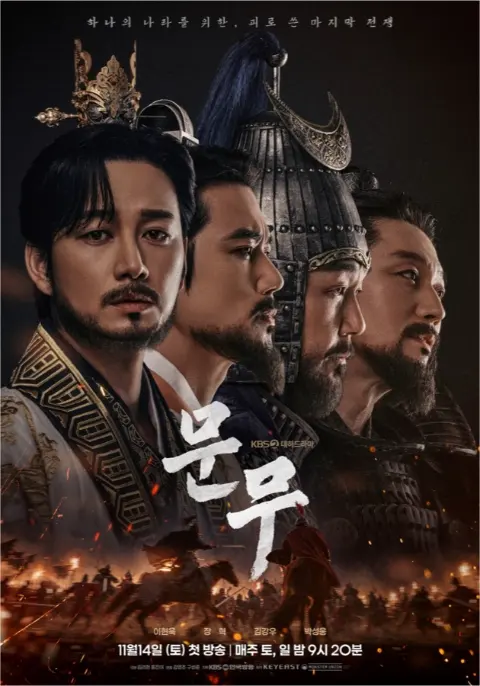
Munmu
KBS 2TVExplore KBS historical drama Munmu: story, cast and roles, Saturday–Sunday broadcasts at 21:20 KST, 28 episodes, official live TV and TVING replays.