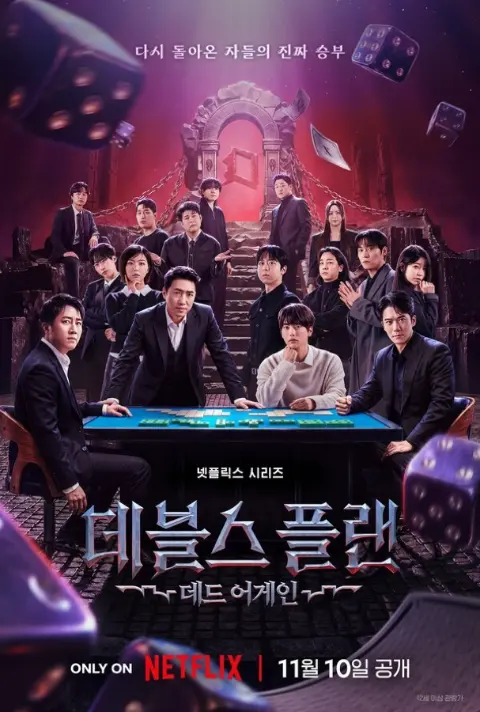
The Devil’s Plan 3: Zero Pieces, elimination rules and Exile explained
Zero Pieces no longer means automatic elimination in The Devil’s Plan 3. Compare season rules, Exile’s return opportunity and an early match’s rewards to understand strategy and survival.
Spoilers for Exile’s structure and task format, and an episodes 1–5 game / No elimination-order or winner results / Hypothetical calculation included

Zero Pieces and elimination are different conditions
Having zero Pieces does not automatically eliminate a player in The Devil’s Plan Season 3. Netflix announced that, unlike the previous two seasons, exhausting Pieces in The Devil’s Plan: Dead Again no longer triggers automatic elimination; survival depends on match outcomes. [1]
A low resource count alone therefore cannot identify the next player to leave. Separate a player’s holdings, the current match’s elimination condition and any subsequent opportunity to return. This essay explains season-specific rules and the role of Exile before examining resources, alliances, information and risk.
Spoiler notice: This article discusses basic season rules, a reward structure from episodes 1–5 and the existence and purpose of Exile. It does not reveal the elimination order or championship result. Strategic interpretations are STARSCOPE’s analysis; the later calculation is hypothetical, rather than a televised rule.
1. Identify the season before interpreting a rule
Netflix Tudum’s Season 1 guide distinguishes main matches from prize matches. The bottom two players in a main match go to jail and miss the prize match, where contestants work toward a shared objective to build the prize fund. [2]
The Season 2 Death Room guide describes main and prison matches. Pieces support negotiations and purchases; losing all of them means immediate elimination. [3] Netflix’s Dead Again announcement changes that link between losing all Pieces and automatic elimination. [1]
Scroll the table horizontally to read all columns.
| Season | Structure identified in official material | What to watch first |
|---|---|---|
| Season 1 | Main matches and shared-objective prize matches | The difference between personal position and a collective prize |
| Season 2: Death Room | Main and prison matches; zero Pieces means elimination | How resources connect to survival risk |
| Season 3: Dead Again | Zero Pieces does not automatically eliminate a player; match results determine survival | The precise elimination condition for the current match |
This is a reading guide, rather than a complete rulebook. Scoring, penalties, ties and transfer conditions must be checked against the rules actually announced. A change to one condition does not establish that every earlier mechanism has disappeared.
2. Exile: distinguish losing Pieces, match elimination and a final exit
A November 17, 2026 release announcement reported by Newsen introduces the Exile survival competition among the material for episodes 6–10. Exile is described as an opportunity for eliminated players to return to the game. [5]
That requires separating three questions: has a player exhausted their Pieces, been eliminated from a match, or exhausted their opportunity to return? A zero balance alone does not settle match elimination. An opportunity in Exile also does not establish a guaranteed return to the main game.
An episodes 6–10 example: interpreting clues in Exile
A November 18 report by 10Asia describes a task involving mysterious symbols and a giant red eye in the Exile material released the previous day. Producer Jeong Jong-yeon explained the intention as giving another opportunity to contestants eliminated before fully demonstrating their abilities. [6]
Read alongside the revised Pieces rule, this example separates losing resources from having an opportunity to attempt another challenge. It also raises a question about evaluating clue interpretation and resource acquisition on the same scale. This is analysis of the reported task structure, rather than a claim to have watched the scene or a judgment of anyone’s performance.
Exile’s existence does not establish every condition for entry, return or final departure. Puzzle solutions, individual results and return counts not verified in this research are omitted.
3. Read Pieces as available choices, rather than a single number
The Season 2 guide provides a useful example: Pieces serve negotiations and purchases, while low holdings also affect prison placement. [3] The analytical point is that a resource’s value depends on when and how it can be used.
A resource unavailable in the current match might offer little protection against an immediate loss. Spending it now might also reduce the choices available later. Ask not only who holds the most, but who can use what they hold and what they give up by doing so.
The same questions can be taken into Dead Again, without assuming it retains earlier purchase or transfer conditions. Check separately whether Pieces protect survival, enable an action or have another role in the current game. Removing automatic elimination does not establish that Pieces have become meaningless.
4. An alliance depends on how benefits are distributed
In a 2023 Kyunghyang Shinmun interview about Season 1, producer Jeong Jong-yeon described Orbit as consistent in his philosophy and discussed how his collective-survival approach produced an unfamiliar storyline for the format. [4] That provides a reason to examine how a shared objective changes a game, alongside the personalities involved.
An actual reward structure: the first match in episodes 1–5
The same announcement looks back at episodes 1–5 to describe the first main match, “Yangja Taegil,” or a choice between two options. If at least nine of the sixteen players choose the public interest, the prize fund increases; if that condition fails, only those choosing personal interest receive five victory points. [5]
The analytical distinction is between a collective prize and personal points. A shared objective requires enough people to choose the same direction, while its failure rewards a different choice. That invites asking what grounds a player had for expecting others to honor an agreement, alongside how cooperative someone appears. This does not establish anyone’s private motives or actual choice. It is an early-season example, rather than a new match from episodes 6–10.
STARSCOPE’s suggested framework is the reason to join, the reason to stay and the conditions for leaving. Pooling information may help, but an arrangement that concentrates rewards in one person’s hands raises a different question about stability. A plan requiring someone’s sacrifice also requires examining their incentive to follow it.
Watch who controls essential information or the order of actions, who receives the rewards and risks, and whether the group still needs each other in the next match. A larger group is not automatically more efficient or more durable.
5. Separate available information from verified information
What a viewer learns from the rules, what only some players know, and what a participant claims without verification are different kinds of information. Treating them as equally established can make a decision appear much easier than it was.
When a player relies on an ally’s claim, ask what could be checked at that moment, as well as whether the claim proved correct. Independent sources, corroborating clues and the opportunities lost while checking can all change the decision.
Also ask who benefits when information is shared. Even accurate information can have different value at different times. Unpublished motives or secret agreements should not be invented to complete an explanation. These are questions for interpreting choices, rather than judgments about any particular contestant.
6. A hypothetical calculation: average reward and elimination risk differ
The following choices are invented for explanation. They do not reproduce a Devil’s Plan game or estimate a contestant’s actual chance of winning.
Scroll the table horizontally to read all columns.
| Hypothetical choice | Resource change | What must be checked |
|---|---|---|
| A: certain reward | Always +1 | Whether a separate elimination condition still applies |
| B: uncertain outcome | +3 on success, −2 on failure | Probability of success, remaining resources and survival after failure |
If B succeeds with probability p, its average resource change is 3p − 2(1−p) = 5p − 2. To exceed A’s +1, p must be greater than 0.6, or 60%. This is arithmetic under stated assumptions, rather than a measurement of anyone’s performance on the show.
An average does not settle the decision. A failure that causes immediate elimination carries a different meaning from a loss followed by another opportunity. If the success probability is not credibly known, declaring a choice to have a higher expected value is premature. Consider average reward, worst outcome and the opportunities that remain afterward separately.
7. Questions to bring into Dead Again
The official announcement establishes that exhausting Pieces and automatic elimination have been separated. It does not establish that aggressive play always benefits a particular player. To evaluate a strategy, first check:
- Survival: Who can be eliminated in this match, and by what condition?
- Resources: When and for what purpose can Pieces be used?
- Relationships: How are benefits and risks distributed among allies?
- Information: What did each participant know, and what could not be verified?
- The next match: Is there room to negotiate or recover after this choice?
An identical resource loss can mean something different under a different survival condition. These questions help connect the rule briefing with subsequent choices and avoid judging a process solely by its outcome.
Frequently asked questions
Does having zero Pieces mean elimination in Dead Again?
Netflix’s announcement says losing all Pieces does not automatically cause elimination. It does not guarantee survival in every circumstance: the match result and its elimination conditions still matter. [1]
Is the biggest alliance always best?
Size alone is insufficient. Consider reward distribution, information control, incentives to carry out required actions and relationships in the following match. This is an analytical framework, rather than a formula predicting a game’s winner.
Where can I find the cast and release information?
The Dead Again work guide provides the cast, release format and official viewing links. This essay focuses on how rules change decisions rather than duplicating that reference page.
Sources and editorial method
Factual claims cite the published sources below. Comparisons, strategic analysis and other interpretations are STARSCOPE’s editorial reading.
- Netflix: Dead Again trailer and revised elimination rule (October 27, 2026) · Netflix · Checked
- Netflix Tudum: Season 1 game structure (April 22, 2025) · Netflix Tudum · Checked
- Netflix Tudum: Death Room Season 2 rules (May 13, 2025) · Netflix Tudum · Checked
- Jeong Jong-yeon interview on Season 1 cooperation (October 15, 2023) · Kyunghyang Shinmun · Checked
- Newsen: Episodes 6–10 release, Exile and early-match structure (November 17, 2026) · Newsen · Checked
- 10Asia: Exile tasks in episodes 6–10 and the producer’s rationale (November 18, 2026) · 10Asia · Checked